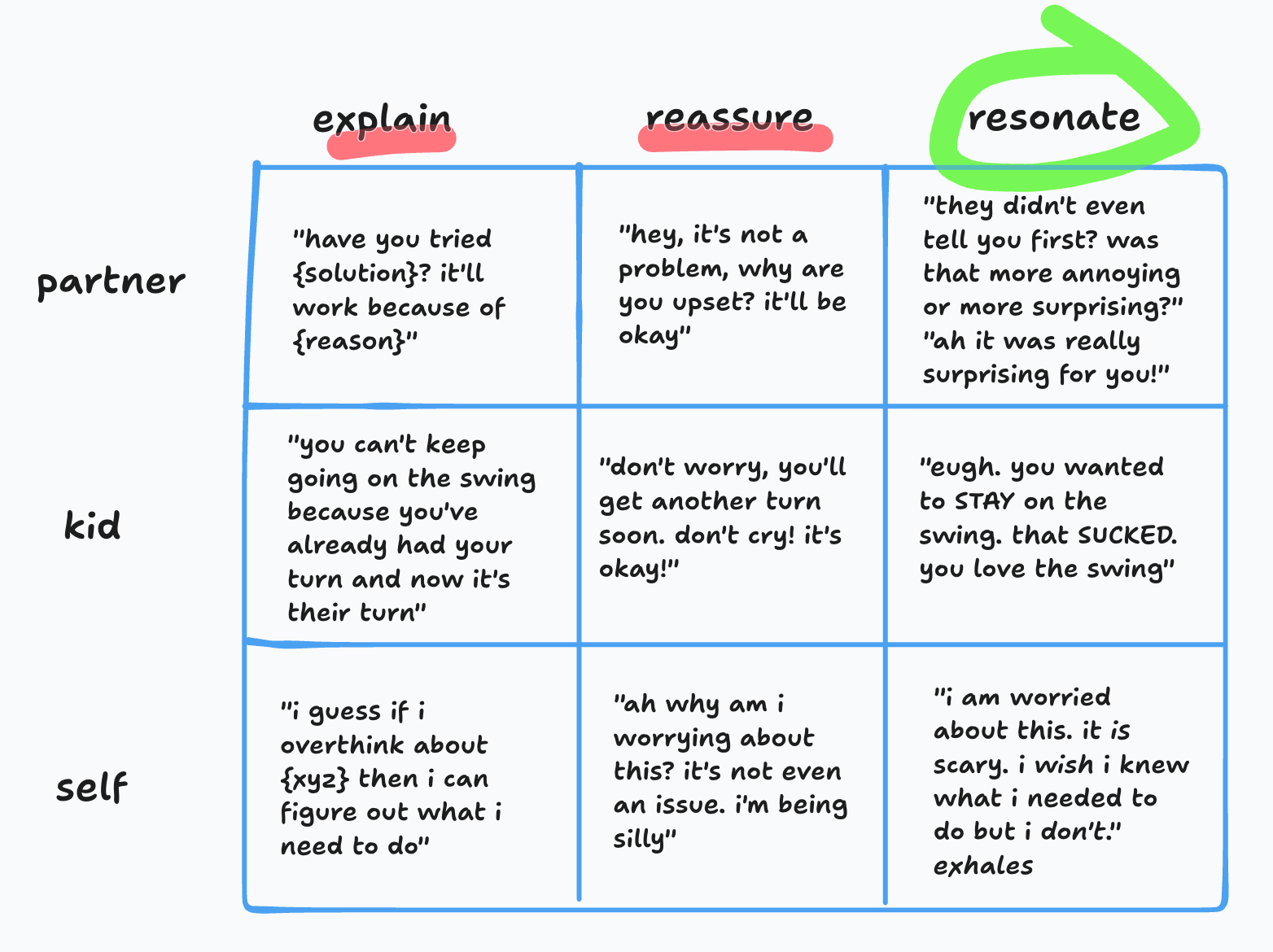
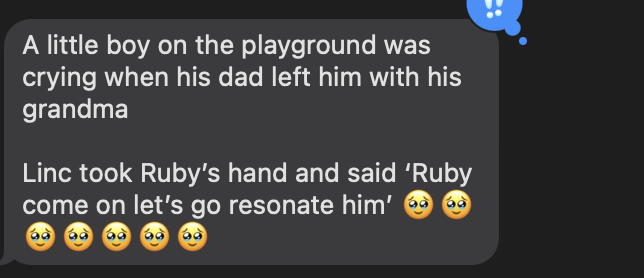
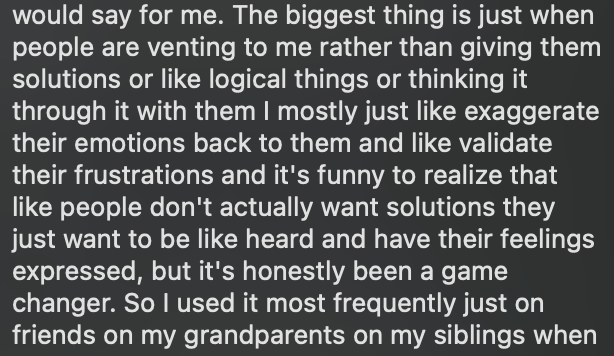
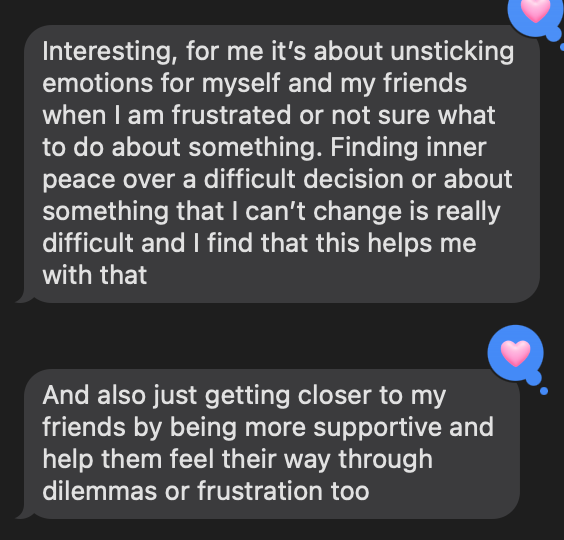
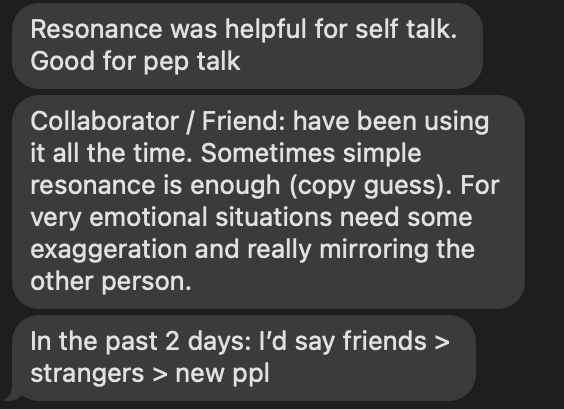
![[chris-barber-image.png|40]] I'm Chris. This is an overview of resonance. The world doesn't teach people how to sit with feelings. So when other people have big emotions, people fix them, explain them away, or use reassurance. Resonance is an alternative. When someone is wanting to vent or get advice, instead of giving them solutions/reassurance/fixes, try resonance. It's similar to active listening. Active listening gives you paraphrasing and open ended questions. Resonance adds on three new tools: copies, guesses, and exaggerations. ![[resonance-table.png]] When emotions are high, using explanations or reassurance buries the other person's emotions. Their emotions stay stuck, unprocessed. Instead, good resonance can help them process/digest their emotions (by feeling seen). Then once the emotions are digested and everyone's feeling neutral, *then* move onto the solutions/logic/fixes, if still needed. It's the same story in parenting, relationships, coaching, with cofounders, and with yourself. Resonance works by making others them feel seen. It has similarities or complements tools like active listening, reflective listening, IFS internal family systems parts work, Gottman parenting, motivational interviewing, Chris Voss, how to talk so kids will listen and 5 love languages. What's the downside? The main downside is that it takes effort to learn. The first 30 minutes of practice are kind of frustrating, it feels robotic and fake, and there's too much to think about. After another 30 minutes, you start to get it, but it's still a lot to think about. Then with a few months of occasional practice you'll get the skill. It's like learning how to ride a bike or learning a new language. ✅ Reflect what they're saying or doing ✅ Guess at what their tone or body language is saying ✅ Help them feel seen and understood ### People love to feel seen, heard, and understood. Here's a 24 second video of me resonating my son - this is a situation where he's stressed, I'm relaxed, and I'm using resonance to support him in processing his emotions. <div style="max-width: 300px;"> <div style="position: relative; padding-bottom: 177.77777777777777%; height: 0;"> <iframe src="https://www.loom.com/embed/549bfa2c9ee447aba15c9430305cfca7?sid=b2e12aa8-522a-4b63-8956-6767747510f2" frameborder="0" webkitallowfullscreen mozallowfullscreen allowfullscreen style="position: absolute; top: 0; left: 0; width: 100%; height: 100%;"> </iframe> </div> </div> ### To learn the basics, check these videos [[Parenting Resonance Examples]] [[Self Resonance Examples]] [[Relationship Resonance Examples]] [[Friendship Resonance Examples]] Podcast excerpt: <div style="position: relative; padding-bottom: 56.25%; height: 0;"><iframe src="https://www.loom.com/embed/fac2ab803f0c4b8887f627958c6a34cb?sid=5f56fa26-728f-4b9c-9c79-98ac75f187fe" frameborder="0" webkitallowfullscreen mozallowfullscreen allowfullscreen style="position: absolute; top: 0; left: 0; width: 100%; height: 100%;"></iframe></div> Full episodes 1. Josh's podcast: [Spotify](https://open.spotify.com/episode/3GWncyea7Fh7pk7xLn5pLe?si=6a3b93c54f444531), [Apple](https://podcasts.apple.com/us/podcast/the-way-you-lead/id1475360470?i=1000717756232), [YouTube](https://www.youtube.com/watch?v=6E4zfwAPaFA) 2. Daniel's podcast: [Twitter/X](https://x.com/dkazand/status/1927849362153165169), [Spotify](https://open.spotify.com/episode/10gCmUIpNMON52x38npn9v?si=nlwXb3PoRQaUuUgk0CZBPQ), [Apple](https://podcasts.apple.com/ca/podcast/36-chris-barber-how-to-regulate-emotions-with-words/id1634047573?i=1000710344965), [YouTube](https://www.youtube.com/watch?v=DlMFd6z8LCQ) ### FAQ **More examples?** Here are [[Two more resonance with kids examples]]. **How to use this for self-regulation?** [Guide](https://x.com/chrisbarber/status/1930729537035509794). **Will the other person notice it's a technique or feel like it's condescending? Does it still work?** Yes, they might notice it's a technique, and yes, it can still work. When you're learning and you want to use it in a close relationship, give them a heads up in advance: If you'd like to use it with your partner or kids or similar, give them a heads up that you'll try it out, and give them a heads up that they'll probably think "what are you doing" and that it's weird. Ask them to let you try it in 10 conversations anyway. Instead of telling them this in a high stakes moment, give them the heads up at a different time when nothing is going on. Start with practicing in situations that don't involve you, before using it in arguments. Resonance works great in arguments if you already have the skill. Resonance doesn't work well to learn *during* an argument. **What are the limitations of resonance?** If you have no desire to make the other person feel seen and understood, it won't work well - in those situations, perhaps get 5-10 minutes of alone time, or try resonating with yourself (talk to yourself out loud, mirroring yourself, without judgement or trying to shift what you're feeling). If you're in an argument - resonance can work - but only if you've already got the skills. You can't learn it in high stakes situations - you need to learn it in low stakes situations. If your kid is having a tantrum - resonance can prevent tantrums, but it doesn't work well for stopping them after they've already started. **How might you use it as a parent?** 1. Easy - As a way to connect and listen to your kids during car rides: asking them about their experiences, and purely reflecting, without reassurance, instead, sitting with their experiences and feelings. 2. Easy - As a way to connect and listen to your kids pre-bed: being present with their emotions. 3. Easy - As a way to play with your kids by observing and describing what they're doing without adding any of your opinions or direction. 4. Medium - When your kid is crying or upset, and you're calm and relaxed: to help them process their emotions. 5. Hard - When you need to enforce boundaries and you want to stay connected during that. These ones are difficult, practice with easy ones first. **What are the common mistakes?** 1. People over-paraphrase and slip advice or opinions into their paraphrases. 2. People put advice or solutions into their guesses. 3. People tell the other person what they think or what they realize, rather than staying with what the other person is saying and showing. In general, our impulse to fix someone else's emotions is strong, and so that leads us to want to reassure. We can't handle their emotions, so we want to fix them. Using resonance helps you build the muscle to stay present with someone else's emotions or your own emotions. **What are the common hesitations when learning?** 1. This feels robotic. 2. This feels fake. 3. There's a lot to think about, so I can't be present in the conversation. Yes, learners commonly feel all three of those. What I've seen is that after about 30-60 minutes of practice, those challenges start to fade. So, it's helpful to expect that you might feel those at first. **How do you know if it worked?** If the other person says "yes, exactly!!" or they breathe a sigh of relief or they become much more open or relaxed. **What other tools have I tried that I now use resonance instead of?** IFS (internal family systems), coherence therapy, core transformation, conscious leadership group clearing model, focusing and felt sense, alexander technique, wholeness method, the five love languages and apology languages, Swedish massage, John Sarno (it combines well, basically you can just resonate body parts/areas), somatic experiencing, bioemotive, motivational interviewing, ACT, CBT, transcendental meditation. My favorite other tools are, in order: core transformation, John Sarno, Swedish massage, 5 love languages, and IFS. **If I resonate them do I have to give them what they want / do I have to agree?** You don't have to agree with them. You can resonate even when you disagree: e.g. "you really think the sky is green - and you wish I thought the sky was green too!" If you're in a disagreement, resonance can work well, *if* you've already gotten an hour of practice in easier situations. If you have, try resonating them first until they feel totally understood and they say "yes exactly you get it" - then take some space for 5-10 minutes, then come back and decide what you want to do. If you're in a disagreement but haven't practiced resonance much yet, skip it for now, practice in low stakes and try in a future disagreement. [Longer answer](https://x.com/chrisbarber/status/1932088334782025854). I've collected [more resources/questions in my replies here](https://x.com/chrisbarber/status/1927854298513428992). *Thank you to the people who inspired this: Nina, Matt Mochary, Alejandro Martinez, Mark Andreas, Tamara Andreas, and Steve Freund. Thank you to my friends for being beta testers.* ### Quotes from friends about how they use resonance ![[josh-singer.png|40]] **Josh Singer** (uses resonance with partner, coworkers) > Who Josh uses resonance with: > ![[Pasted image 20250917063145.png|400]] ![[george-zeng.png|40]] **George Zeng** (partner resonance) > ![[Pasted image 20250917061447.png|400]] ![[nina-barber 1.png|40]] **my wife Nina** (with herself, with me, with our kids) > ![[Pasted image 20250917061909.png|400]] > ![[Pasted image 20250917062322.png|400]] > ![[Pasted image 20250917062427.png|400]] > ![[Pasted image 20250917062359.png|400]] > ![[Pasted image 20250917062453.png|400]] **my brother** (self with decisions, supporting friends) > ![[Pasted image 20250917061352.png|400]] **Alton Sun** (with friends, with partner) > ![[images/Pasted image 20241203054624.png|400]] ![[maile-minardi.png|40]] **Maile Minardi** (friends, relatives) > ![[Pasted image 20250917063031.png|400]] ![[ben_circular_noresize.png|40]] **Ben Pan** (self, friends, anyone) > "I think it's one of the most useful skills I've ever learned. And I think it'll just get better and better." > ![[Pasted image 20250917062035.png|400]] > ![[Pasted image 20250917061607.png|400]] **Justin Yang** (supporting friends) > ![[Pasted image 20250917085442.png|400]] **my sister** (nursing patients, friends) > ![[images/Pasted image 20241203054825.png|400]] > ![[Pasted image 20250917061642.png|400]] About me: [[Chris Barber]]